A lead-routing workflow can look finished when the happy path works: a form submission enters n8n, enrichment runs, an AI model scores the lead, the CRM gets updated, and a salesperson receives a notification. The real challenge is handling the failures that happen when the workflow is running at scale.
The problems start when the same webhook arrives twice, an enrichment API returns HTTP 429, the CRM creates a contact but rejects the owner update, two executions claim the same salesperson, or a routing rule changes while leads are already in flight.
For a B2B team processing 500 inbound leads per day, even a 1% failure or duplication rate creates five records that need investigation every day. At 5,000 leads per day, the same architecture becomes an operational problem rather than just a workflow problem.
This guide shows how to build automated lead routing in n8n around deterministic state, idempotent writes, explicit routing precedence, retry budgets, dead-letter handling, and replayable failures.
What Is a Reliable n8n Lead Router?
The first design decision is to treat routing as a state machine rather than a simple chain of nodes.
The most common n8n lead-routing mistake is treating the workflow as a linear sequence:
Webhook → Enrich → AI Score → CRM → SlackThat sequence hides the states that matter operationally. A lead can be received but not validated, enriched but not qualified, qualified but not assigned, assigned but not persisted, or persisted but not notified.
Model those states explicitly:
RECEIVED
   ↓
VALIDATED
   ↓
DEDUPLICATED
   ↓
ENRICHED
   ↓
QUALIFIED
   ↓
ROUTED
   ↓
PERSISTED
   ↓
NOTIFIED
   ↓
COMPLETE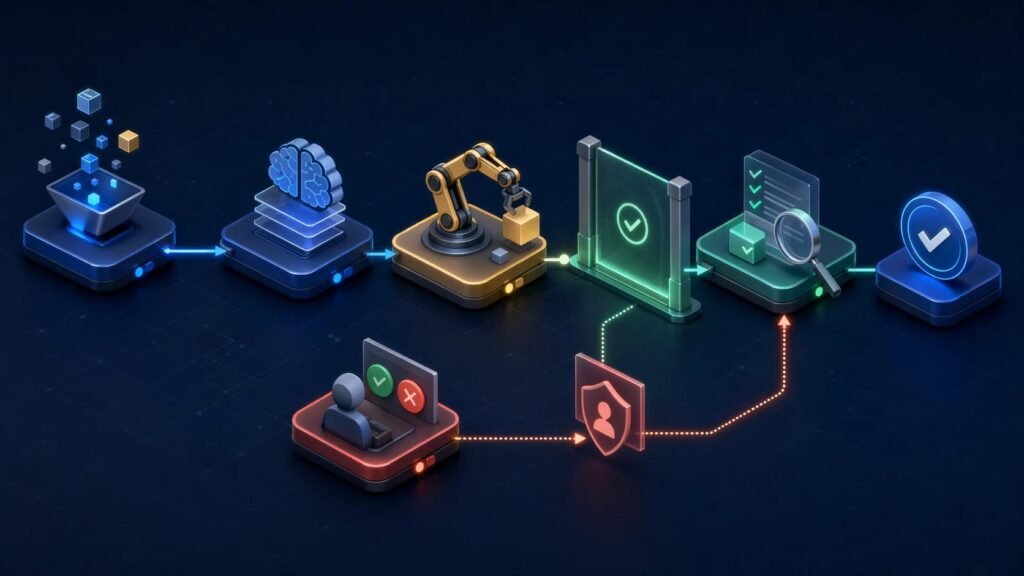
A failure should move the lead into a known state rather than simply terminating an n8n execution.
For example, an enrichment timeout should result in ENRICHMENT_RETRY or ENRICHMENT_FAILED. A CRM assignment failure should not send the workflow back to the beginning and create another contact.
Use a Canonical Lead Object
Incoming payloads rarely have the same shape. A website form might send email, company, and job_title. Another source might send workEmail, organization, and title.
Normalize those fields once, then make the rest of the workflow consume a canonical object.
{
  "source": "website",
  "source_event_id": "evt_01JX9...",
  "received_at": "2026-10-07T12:00:00Z",
  "email": "alex@example.com",
  "email_domain": "example.com",
  "first_name": "Alex",
  "last_name": "Morgan",
  "job_title": "VP Engineering",
  "company_name": "Example Inc",
  "country": "US",
  "employee_count": null,
  "industry": null,
  "crm_contact_id": null,
  "crm_account_id": null,
  "qualification_score": null,
  "route": null,
  "route_reason": null,
  "routing_version": "2026-10-01"
}
Keep source-specific fields separately if they are useful for attribution, but do not let every downstream node understand every form provider’s schema.
How to Build the n8n Lead-Routing Workflow
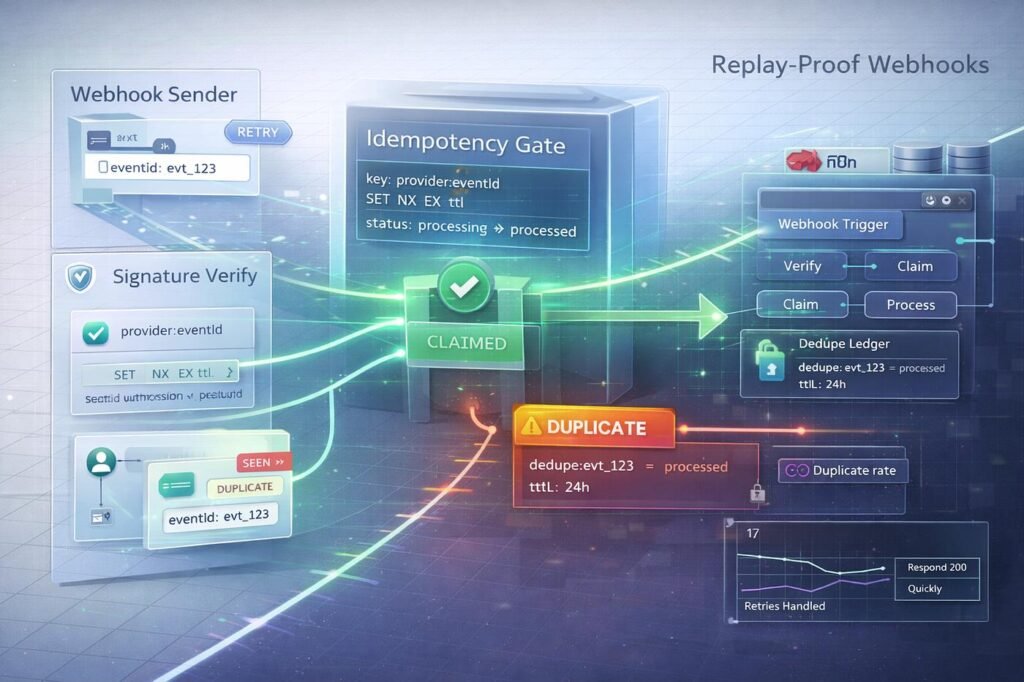
Make Duplicate Delivery Harmless with Idempotency
Webhooks are not guaranteed to arrive exactly once. A source can retry after a timeout even when n8n successfully processed the original event. Your router therefore needs an idempotency strategy.
Do not use email address alone as the idempotency key. The same person may legitimately submit multiple forms, request multiple demos, or enter different campaigns.
Prefer the originating system’s event ID. If the source does not provide one, construct a deterministic key from stable source information and an intentional event boundary.
idempotency_key =
  source + ":" + source_event_id
Store the key before performing irreversible side effects.
CREATE TABLE lead_events (
  id BIGSERIAL PRIMARY KEY,
  idempotency_key TEXT UNIQUE NOT NULL,
  source TEXT NOT NULL,
  source_event_id TEXT,
  status TEXT NOT NULL,
  routing_version TEXT,
  created_at TIMESTAMPTZ NOT NULL DEFAULT NOW(),
  updated_at TIMESTAMPTZ NOT NULL DEFAULT NOW()
);
If the insert violates the unique constraint, the workflow knows that another execution already claimed the event.
Idempotency is not the same as deduplication. Deduplication asks whether two records represent the same entity. Idempotency asks whether the same operation can safely execute more than once.
Resolve Account Ownership Before Round-Robin Assignment
A common routing error is to start with geography and round robin:
US lead → US team → next available repThat can be wrong when the company already belongs to an account executive. A subsidiary may submit a form while the parent account is owned by another rep. Routing should preserve account ownership unless a deliberate business rule says otherwise.
A practical precedence order is:
- Explicit account ownership.
- Existing open opportunity ownership.
- Named strategic-account assignment.
- Product or segment specialization.
- Geographic territory.
- Capacity-aware round robin.
- Fallback queue.
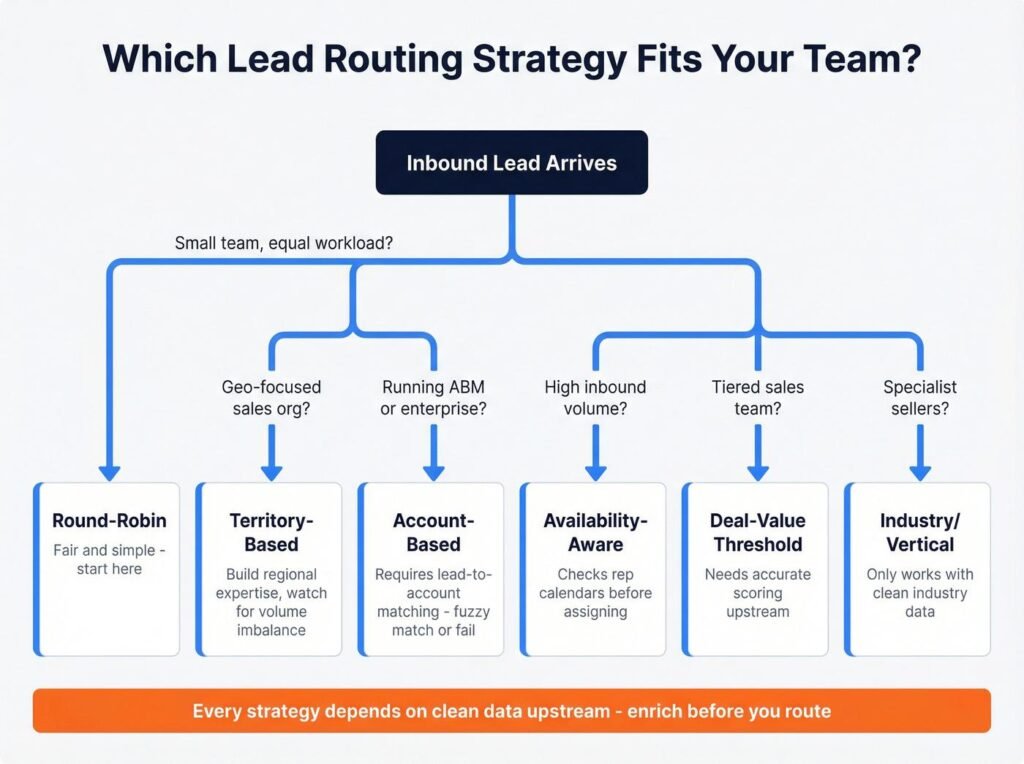
This order should be data-driven rather than buried inside dozens of IF branches.
Represent Routing Rules as Data
If the routing logic changes every time a territory changes, the workflow itself should not require editing.
Store assignments in a table or controlled configuration source.
CREATE TABLE routing_rules (
  rule_id TEXT PRIMARY KEY,
  priority INTEGER NOT NULL,
  region TEXT,
  segment TEXT,
  employee_min INTEGER,
  employee_max INTEGER,
  product TEXT,
  owner_id TEXT,
  active BOOLEAN NOT NULL DEFAULT TRUE,
  version TEXT NOT NULL
);
The router evaluates the rules from highest priority to lowest priority. The first valid deterministic match wins.
This also makes rule changes auditable. If a lead was routed incorrectly three weeks later, you can determine which rule version made the decision.
Build the n8n Workflow Around Failure Boundaries
A useful n8n architecture is not one enormous canvas. Separate operations that have different failure and retry characteristics.
Webhook Trigger
      │
      ├── Validate Signature
      │
      ├── Normalize Payload
      │
      ├── Claim Idempotency Key
      │
      ├── Match Existing CRM Records
      │
      ├── Enrichment Sub-workflow
      │
      ├── Qualification
      │
      ├── Routing Engine
      │
      ├── CRM Persistence
      │
      ├── Notification
      │
      └── Audit / Metrics

Failure Path
      │
      └── Dead-Letter Record → Alert → Replay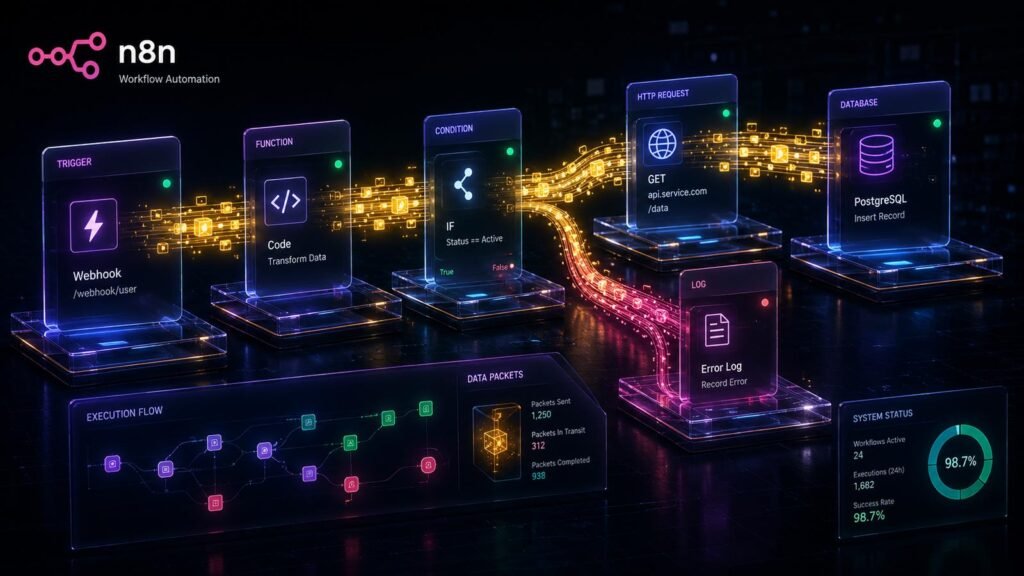
The enrichment and notification operations are good candidates for sub-workflows because they have distinct retry behavior and external dependencies.
Validate the Webhook Before Spending API Calls
Reject malformed requests before calling enrichment providers or CRM APIs. At minimum, validate required fields and basic email syntax.
const input = $json;

const errors = [];

if (!input.email) {
  errors.push("missing_email");
}

if (!input.source_event_id) {
  errors.push("missing_source_event_id");
}

if (input.email && !/^[^@\s]+@[^@\s]+\.[^@\s]+$/.test(input.email)) {
  errors.push("invalid_email");
}

return [{
  json: {
    ...input,
    valid: errors.length === 0,
    validation_errors: errors
  }
}];
If the upstream platform supports webhook signatures, verify the signature before parsing the payload as trusted business data.
Keep Deterministic Routing Separate from AI
AI can help interpret unstructured information, classify industry, summarize a lead, or estimate ICP fit. It should not silently become the owner of deterministic assignment logic.
For example, let an AI classifier produce:
{
  "industry": "cybersecurity",
  "segment": "mid_market",
  "icp_score": 87,
  "reason": "B2B security vendor with approximately 500 employees"
}
Then let deterministic routing rules decide the owner:
if existing_account_owner:
    assign existing_account_owner

else if icp_score < 50:
    assign nurture_queue

else if segment == "enterprise" and industry == "cybersecurity":
    assign enterprise_security_rep

else if country == "US":
    assign capacity_aware_us_pool

else:
    assign fallback_queue
This separation makes routing explainable and prevents a prompt change from silently changing sales ownership.
Handle Rate Limits with Bounded Exponential Backoff
A lead router can easily create a burst of API traffic. Imagine 500 form submissions entering the system within 10 minutes. If every lead requires two enrichment requests and one CRM lookup, that is already 1,500 external calls before CRM writes or notifications.
Fixed five-second waits are a poor retry strategy. Use bounded exponential backoff with jitter.
const attempt = Number($json.attempt || 0);

const baseDelay = 1000;
const maxDelay = 30000;

const exponential = Math.min(
  maxDelay,
  baseDelay * Math.pow(2, attempt)
);

const jitter = Math.floor(Math.random() * 500);

return [{
  json: {
    ...$json,
    retry_delay_ms: exponential + jitter,
    next_attempt: attempt + 1
  }
}];
A reasonable starting policy for a lead router is three to five retries for transient failures, with a maximum retry window appropriate to the sales SLA.
Do not retry every status code. Authentication failures, invalid requests, schema errors, and permanent 4xx responses normally require correction rather than repetition.
| Response | Typical treatment |
|---|---|
| 200–299 | Continue |
| 400 / 422 | Validate payload; normally do not retry automatically |
| 401 / 403 | Credential or permission incident |
| 404 | Check resource mapping; normally do not blindly retry |
| 429 | Retry using provider guidance and backoff |
| 500 / 502 / 503 / 504 | Bounded retry with backoff |
Prevent Partial CRM Writes from Creating Duplicate Leads
Consider this sequence:
- n8n creates the CRM contact successfully.
- The CRM API times out before n8n receives the response.
- n8n assumes creation failed.
- The retry creates another contact.
The timeout does not tell you whether the remote operation succeeded. This is why idempotency must extend to external writes.
Where the CRM supports an external ID or idempotency key, send one. Otherwise, search for a stable existing identifier before creating a new object and store the returned CRM ID in your routing state.
{
  "external_lead_id": "website:evt_01JX9...",
  "crm_contact_id": "contact_98231",
  "crm_account_id": "account_1837",
  "assignment_status": "assigned",
  "notification_status": "pending"
}
The important distinction is that the workflow records what actually happened rather than inferring success from whether an HTTP request returned before the timeout.
Use a Dead-Letter Path Instead of Infinite Retries
Some leads will fail repeatedly. Keeping them in an automatic retry loop wastes API quota and makes incident investigation harder.
After the retry budget is exhausted, write a dead-letter record.
{
  "lead_id": "lead_92831",
  "failure_stage": "crm_assignment",
  "error_code": "CRM_503",
  "attempt_count": 5,
  "first_failed_at": "2026-10-07T12:01:32Z",
  "last_failed_at": "2026-10-07T12:08:11Z",
  "routing_version": "2026-10-01",
  "replayable": true
}
Alert the responsible operator with enough context to diagnose the issue, but do not put unnecessary PII into Slack, email, or incident systems.
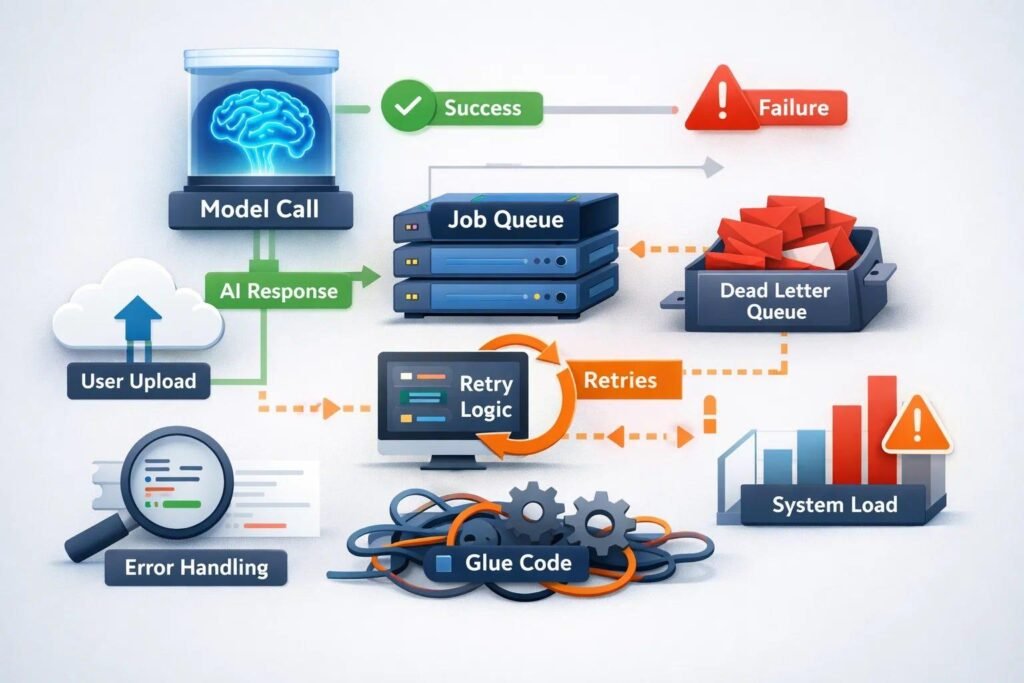
Replay Failures Without Repeating Successful Side Effects
A replay mechanism should resume from the failed state whenever possible. If enrichment succeeded and CRM persistence failed, replaying the entire workflow should not call the enrichment provider again unless the data has expired.
RECEIVED
  ↓
VALIDATED
  ↓
DEDUPLICATED
  ↓
ENRICHED       ← already complete
  ↓
QUALIFIED      ← already complete
  ↓
ROUTED         ← already complete
  ↓
CRM_FAILED     ← resume here
  ↓
NOTIFIED
  ↓
COMPLETE
This is one of the strongest reasons to persist state outside the transient execution graph.
Use Capacity-Aware Round Robin
A five-person sales team does not necessarily have five equal routing slots. One rep may be at 90% capacity while another has room for 20 new leads.
Store routing capacity explicitly.
| Rep | Weight | Active Leads | Capacity | Eligible |
|---|---|---|---|---|
| Rep A | 1.0 | 12 | 30 | Yes |
| Rep B | 1.0 | 29 | 30 | No |
| Rep C | 0.5 | 8 | 20 | Yes |
This prevents a mathematically fair algorithm from becoming operationally unfair.
Set an Explicit SLA for the Routing Workflow
Lead routing should have a measurable service objective. For example:
- 95% of qualified leads assigned within 60 seconds.
- 99% of valid webhook events persisted within five minutes.
- 100% of failed assignments recorded in the dead-letter store.
- Zero duplicate CRM contacts caused by workflow retries.
- 100% of routing decisions include a route reason and routing version.
These metrics are more useful than simply measuring how many n8n executions succeeded.
Test the Router with Failure Injection
Before connecting the workflow to live sales ownership, run synthetic leads through every important branch.
| Test | Expected result |
|---|---|
| Same webhook delivered twice | One business operation |
| Malformed email | Validation failure; no enrichment call |
| Existing account owner | Existing owner wins over round robin |
| Enrichment returns 429 | Bounded retry with backoff |
| CRM returns 503 | Retry, then dead-letter |
| CRM create succeeds but response times out | Retry does not create a second contact |
| AI returns malformed JSON | Validation failure or deterministic fallback |
| No eligible sales rep | Fallback queue, not silent failure |
| Routing rule changes during processing | Lead retains a recorded routing version |
| Failed lead replayed | Successful previous side effects are not duplicated |
Routing Options and Precedence
Routing should use explicit rules rather than scattered conditional logic. The following order keeps ownership decisions predictable.
Account Ownership
Explicit account ownership takes precedence when an existing account relationship should be preserved.
Open Opportunities
Existing open opportunity ownership can determine which salesperson should receive the lead.
Strategic Accounts
Named strategic-account assignments can override broader territory or round-robin rules.
Specialization
Product or segment specialization can determine the best eligible salesperson.
Territory
Geographic territory can be used when higher-priority ownership rules do not apply.
Capacity-Aware Round Robin
Use rep capacity to distribute eligible leads instead of assuming every salesperson has the same available capacity.
Fallback Queue
Send leads to a controlled fallback queue when no deterministic salesperson assignment is available.
AI Classification vs. Deterministic Routing
AI can help interpret unstructured information, classify industry, summarize a lead, or estimate ICP fit. The final ownership decision should remain deterministic and explainable.
For example, an AI classifier can produce an industry, segment, ICP score, and reason. The routing engine can then apply explicit business rules to determine the owner.
if existing_account_owner:
    assign existing_account_owner

else if icp_score < 50:
    assign nurture_queue

else if segment == "enterprise" and industry == "cybersecurity":
    assign enterprise_security_rep

else if country == "US":
    assign capacity_aware_us_pool

else:
    assign fallback_queue
This separation prevents a prompt change from silently changing sales ownership.
Monitoring and Operational Use Cases
A workflow can be technically healthy while routing the wrong leads. Monitoring should therefore cover both system reliability and routing quality.
System Reliability
Track webhook volume, workflow latency, retries, HTTP 429 responses, HTTP 5xx responses, dead-letter volume, replay count, and CRM write failures.
Routing Quality
Track qualified leads by route, account-match rate, fallback assignments, rep load distribution, assignment time, and conversion rate by routing rule.
Failure Recovery
Monitor failed assignments, dead-letter records, replay activity, retry exhaustion, and the state from which each failure can resume.
Business Outcomes
Compare routing performance with business results instead of relying only on successful n8n executions.
System Metrics
- Webhook volume.
- Workflow execution latency.
- Retry count.
- HTTP 429 rate.
- HTTP 5xx rate.
- Dead-letter volume.
- Replay count.
- CRM write failures.
Routing Metrics
- Qualified leads by route.
- Lead-to-account match rate.
- Fallback assignment rate.
- Rep load distribution.
- Median time from webhook to assignment.
- Percentage of leads reassigned after SLA expiration.
- Conversion rate by routing rule.
If the fallback queue suddenly receives 18% of leads instead of its normal 2%, the routing system has a business problem even if every n8n execution is technically green.
Tips for a More Reliable Lead Router
- Validate the webhook before spending enrichment or CRM API calls.
- Use the originating event ID for idempotency whenever the source provides one.
- Do not use email alone as the idempotency key.
- Keep routing rules in controlled data rather than scattering them across nodes.
- Record the reason and routing version for every assignment.
- Use bounded exponential backoff with jitter for transient failures.
- Do not retry authentication errors, invalid requests, and other permanent failures indefinitely.
- Use dead-letter handling after the retry budget is exhausted.
- Replay from the failed state instead of repeating successful side effects.
- Use capacity-aware assignment when sales capacity affects routing.
- Test duplicate delivery, timeouts, rate limits, malformed AI output, and routing changes before enabling live ownership.
- Keep observability focused on both technical reliability and business outcomes.
Implementation Checklist
- Webhook authenticity is verified where supported.
- Input schema is validated before external API calls.
- Every source event has an idempotency key.
- Duplicate delivery does not duplicate CRM records.
- Account ownership takes precedence where required.
- Routing rules are stored as data rather than scattered through nodes.
- Every route has an explainable reason.
- Every routing decision records a version.
- 429 and transient 5xx responses have bounded retries.
- Permanent errors do not enter infinite retry loops.
- Failed executions enter a dead-letter path.
- Replay resumes from the failed state when possible.
- CRM writes are idempotent.
- Sales capacity is represented explicitly if it affects assignment.
- Credentials are isolated by environment.
- PII is minimized in logs and alerts.
- Synthetic leads cover every critical routing branch.
- Latency, retry, failure, fallback, and assignment metrics are visible.
When n8n Should and Should Not Own the Routing System
n8n is well suited to orchestration, API coordination, transformation, branching, notifications, and business-process automation. It does not automatically need to become the database, queue, policy engine, and transactional system for every workload.
Move state into Postgres or another appropriate datastore when you need durable idempotency, assignment history, replay state, routing versions, or transactional coordination.
Consider a dedicated queue when burst traffic is high enough that external API rate limits, execution concurrency, or latency requirements make direct synchronous processing undesirable.
A Practical Architecture
n8n
  = orchestration and business workflow

Database
  = durable state, idempotency, routing history

External APIs
  = enrichment, CRM, messaging

Queue
  = burst absorption and asynchronous processing

Observability
  = metrics, alerts, audit, replay
Reference Architecture
                    ┌────────────────────┐
                    │ Website / Forms     │
                    └─────────┬──────────┘
                              │
                              ▼
                    ┌────────────────────┐
                    │ n8n Webhook        │
                    │ Signature + Schema │
                    └─────────┬──────────┘
                              │
                              ▼
                    ┌────────────────────┐
                    │ Normalize Payload  │
                    └─────────┬──────────┘
                              │
                              ▼
                    ┌────────────────────┐
                    │ Idempotency Claim  │
                    │ Postgres           │
                    └─────────┬──────────┘
                              │
                    ┌─────────▼──────────┐
                    │ Existing Account?  │
                    └──────┬────────┬────┘
                           │ Yes     │ No
                           ▼         ▼
                    Existing Owner  Enrichment
                                      │
                                      ▼
                               Qualification
                                      │
                                      ▼
                              Routing Policy
                                      │
                 ┌────────────────────┼──────────────────┐
                 │                    │                  │
                 ▼                    ▼                  ▼
             Territory            Capacity          Fallback
                 │                    │                  │
                 └────────────────────┼──────────────────┘
                                      │
                                      ▼
                              CRM Persistence
                                      │
                                      ▼
                               Sales Notification
                                      │
                                      ▼
                                Audit + Metrics

Failure at any external boundary
                    │
                    ▼
             Retry / Backoff
                    │
             exhausted retries
                    ▼
              Dead-Letter Queue
                    │
                    ▼
                 Replay
Privacy, Credentials, and Environment Separation
Development, staging, and production should not share credentials simply because the workflow structure is identical.
At minimum, isolate:
- CRM credentials.
- Enrichment API credentials.
- Notification credentials.
- Database connections.
- Webhook endpoints.
A staging test should never be capable of assigning a real production lead to a salesperson.
Alert the responsible operator with enough context to diagnose failures, but do not put unnecessary PII into Slack, email, or incident systems.
Credentials should also remain isolated by environment so development and staging systems cannot accidentally operate on production data.
Frequently Asked Questions
Why should lead routing be treated as a state machine?
A lead can move through several operational states, such as received, validated, enriched, qualified, routed, persisted, and notified. Explicit states make failures recoverable instead of simply terminating an n8n execution.
Should email address be used as the idempotency key?
No. The same person may legitimately submit multiple forms, request multiple demos, or enter different campaigns. The originating system’s event ID is preferred when available.
Should AI decide which salesperson receives a lead?
AI can help classify industry, summarize a lead, or estimate ICP fit, but deterministic routing rules should make the final ownership decision. This keeps the routing process explainable and prevents prompt changes from silently changing ownership.
What should happen when an enrichment API returns HTTP 429?
Use bounded retries with exponential backoff and jitter, following the provider’s guidance. Do not retry every response automatically, and do not allow transient failures to create an infinite retry loop.
Why is a CRM timeout dangerous?
A timeout does not prove that the CRM operation failed. The CRM may have created the contact successfully even though n8n did not receive the response. Retrying without an idempotency strategy can therefore create a duplicate contact.
Why use a dead-letter path?
Some failures will continue after the retry budget is exhausted. A dead-letter record preserves the failure details for investigation and allows the lead to be replayed without keeping it in an endless retry loop.
When should routing state move into Postgres?
Use Postgres or another appropriate datastore when the workflow needs durable idempotency, assignment history, replay state, routing versions, or transactional coordination.
What should be tested before live routing is enabled?
Test duplicate webhooks, malformed input, existing account ownership, API rate limits, CRM failures, CRM timeouts, malformed AI output, missing sales capacity, routing-rule changes, and replay behavior.
The Engineering Standard for an Automated n8n Lead Router
The goal is not to create the shortest workflow. It is to make the routing decision deterministic, observable, reversible, and safe to retry.
A useful automated lead router should answer five questions for every lead:
- What event created this lead?
- Have we already processed that event?
- What data did we use to qualify and route it?
- Why did this particular salesperson or queue receive it?
- Can we safely replay the operation if something failed?
If those answers are not recoverable from the system, the workflow is difficult to operate regardless of how impressive the n8n canvas looks.
For B2B teams, the highest-value improvement is usually not another AI node. It is explicit state, deterministic ownership rules, idempotent writes, controlled retries, and an audit trail that lets an engineer reconstruct what happened without guessing.
Build Your Routing Workflow Around Failure Cases First
If your current n8n workflow already routes inbound leads but relies on manual deduplication, fixed retry delays, undocumented routing rules, or replaying entire executions after failures, start with an architecture review rather than adding more automation.
Map the current states, external dependencies, ownership rules, retry behavior, and failure paths first. Then implement the smallest change that removes the highest-risk failure mode.