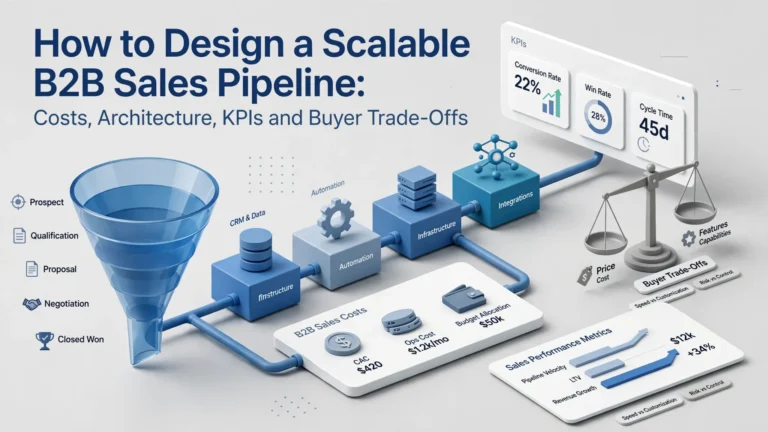
A sales pipeline can contain $5 million in open opportunities and still be worth far less than $1 million. The problem is usually not lead volume. It is state accuracy: deals sitting in the wrong stage, inactive buyers still counted as active, duplicate opportunities inflating coverage, missing decision-makers, and close dates that move every time a forecast review approaches.
A useful B2B pipeline is not just a sequence of sales stages. It is a state-management system with clear transition rules, ownership, data requirements, time limits, and measurable failure states.
Start With the Pipeline Failure, Not the CRM
Consider a mid-market software company with a $1.5 million quarterly quota and an average contract value of $75,000. The CRM contains 60 open opportunities worth $4.5 million. At first glance, the team has 3x pipeline coverage.
A closer inspection finds 12 opportunities with no buyer activity in 30 days, 7 with no identified economic buyer, 5 duplicate opportunities created from separate inbound sources, and 9 with a close date that has already slipped at least once.
The nominal coverage is 3x. The usable coverage is substantially lower.
This distinction is the foundation of good pipeline design: an opportunity should represent a verifiable commercial state, not merely a CRM record.
What a pipeline should be able to answer
- Which accounts are genuinely evaluating the solution?
- Who owns each opportunity?
- Which stakeholder has authority to approve the purchase?
- What event allowed the opportunity to enter its current stage?
- What evidence is required to advance it?
- When did meaningful buyer activity last occur?
- What is the next committed action and who owns it?
- How long has the opportunity remained in its current state?
- What happens when the buyer stops responding?
- Can the forecast system distinguish active pipeline from aging pipeline?
If the CRM cannot answer those questions consistently, adding more automation will mostly make incorrect data move faster.
Model the Pipeline as States With Evidence
A common mistake is to define a pipeline as a list of labels such as Prospecting, Qualification, Discovery, Proposal, Negotiation, and Closed Won.
Labels alone are not enough. Each state needs a business definition and a set of conditions that can be verified.
| Stage | Entry condition | Exit condition | Required evidence |
|---|---|---|---|
| Qualified | ICP fit and credible business problem | Discovery is scheduled with an appropriate stakeholder | Account fit, problem, owner, next meeting |
| Discovery | Buyer conversation has occurred | Business impact and buying process are understood | Problem statement, timeline, stakeholders |
| Solution Evaluation | Problem and use case are confirmed | Solution accepted for commercial evaluation | Technical requirements, success criteria |
| Proposal | Commercial solution is agreed in principle | Proposal is under active buyer review | Pricing, scope, decision date, buyer contacts |
| Negotiation | Commercial terms are being discussed | Terms are accepted or formally rejected | Procurement/legal status, approval path |
| Closed Won | Contractual commitment exists | Handoff completed | Signed agreement, booked value, implementation owner |
The important design principle is that a stage transition should require evidence. “The buyer seems interested” is not a reliable state transition. “The economic buyer has been identified, the business problem has quantified impact, and a decision date has been agreed” is much closer to one.
Separate Account, Contact, Lead, and Opportunity State
B2B pipelines become difficult to operate when everything is stored as one generic “lead.”
An account is an organization. A contact is an individual associated with that organization. A lead is an unqualified acquisition or prospecting record. An opportunity represents a commercial buying motion.
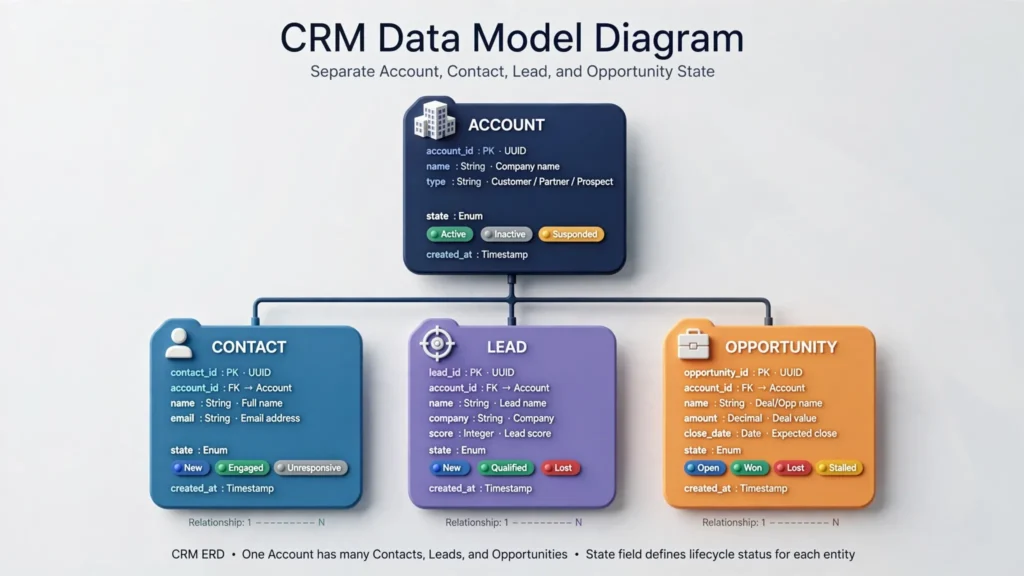
These objects can be related without sharing the same lifecycle.
Account
  ├── Contact: Economic Buyer
  ├── Contact: Technical Evaluator
  ├── Contact: Champion
  ├── Contact: Procurement
  │
  ├── Opportunity A
  │     ├── Stage: Discovery
  │     ├── Value: $75,000
  │     └── Owner: AE-17
  │
  └── Opportunity B
        ├── Stage: Renewal
        ├── Value: $110,000
        └── Owner: AM-04
This matters when the same company has multiple products, business units, regions, renewals, or expansion motions. Treating the company as one opportunity causes unrelated commercial states to contaminate each other.
Build Qualification Around Fit, Intent, and Commercial Reality
ICP criteria answer whether an account resembles a successful customer. They do not prove that the account is currently buying.
A useful qualification model therefore combines three dimensions:
- Fit: industry, size, geography, technology environment, use case, and other ICP attributes.
- Intent: meaningful behavior indicating an active problem or evaluation.
- Commercial reality: business impact, authority, timing, budget path, and purchasing process.
For example, an organization with 2,000 employees may be an excellent ICP match. If there is no active project, no identified problem owner, and no buying event, it should not automatically become a qualified opportunity.
Use disqualification as a first-class state
Pipeline quality improves when teams are allowed to remove opportunities quickly.
A useful closed-lost or disqualified taxonomy might include:
- No active project
- Outside ICP
- No business case
- No decision authority
- Budget unavailable
- Timing deferred
- Existing vendor retained
- Technical requirements not supported
- Competitive loss
- No decision / unresponsive
These reasons turn losses into operational data. A single “Closed Lost” value does not.
Design Routing Before You Increase Lead Volume
A qualified lead that waits six hours for ownership is not equivalent to one that reaches the correct seller in five minutes.
Routing should be deterministic enough that two identical leads produce the same ownership decision.
A practical routing hierarchy
- 1Identify the account using normalized domain and account identifiers.
- 2Check whether the account already has an active owner.
- 3Resolve territory or geographic rules.
- 4Resolve segment or account tier.
- 5Check product or technical specialization requirements.
- 6Check representative availability and capacity.
- 7Apply round-robin assignment when multiple representatives qualify.
- 8Start the response-time SLA.
- 9Escalate automatically when the SLA expires.
if existing_account_owner:
    assign(existing_account_owner)
elif territory_match:
    assign(territory_rep)
elif specialist_required:
    assign(qualified_specialist)
else:
    assign(round_robin(eligible_reps))

start_sla("qualified_lead", 15_minutes)
The important point is not the programming language. It is the explicit decision hierarchy.
Handle ownership failure explicitly
Every routing system needs a fallback for cases where no representative qualifies. Sending the record into an unmonitored queue is not a fallback; it is a hidden failure state.
A safer sequence is:
Qualified lead
    ↓
Eligible owner found?
    ├── Yes → assign + start SLA
    └── No
         ↓
      Operations queue
         ↓
      Alert after 5 minutes
         ↓
      Manager escalation after 15 minutes
         ↓
      Manual assignment
Make Stage Transitions Machine-Checkable
The CRM should prevent a deal from being advanced when the required commercial evidence does not exist.
For example, moving from Discovery to Proposal might require:
- A confirmed business problem
- An identified economic buyer or documented access plan
- A target decision date
- Defined solution requirements
- Expected contract value
- A documented next step
A simplified validation rule could look like this:
function canEnterProposal(opportunity) {
  return (
    opportunity.problemConfirmed === true &&
    opportunity.economicBuyerIdentified === true &&
    opportunity.decisionDate != null &&
    opportunity.requirements.length > 0 &&
    opportunity.amount > 0 &&
    opportunity.nextStep != null
  );
}
This does not mean every field must be mandatory from the first CRM record. Requirements should become stricter as commercial commitment increases.
Do not confuse activity with progress
Ten emails sent do not necessarily represent progress. A buyer replying with “send pricing” is activity. A buyer agreeing to review a proposal with procurement on a specific date is stronger evidence of progression.
Pipeline design should therefore distinguish:
- Seller activity
- Buyer activity
- Buyer commitment
- Internal approval
- Commercial progression
Give Every Opportunity a Decay Model
The most dangerous opportunities are not necessarily closed-lost deals. They are deals that remain technically open long after buyer momentum has disappeared.
Instead of treating an opportunity as either open or closed, introduce operational health states.
| State | Example condition | System response |
|---|---|---|
| Active | Recent meaningful buyer activity | Normal workflow |
| At Risk | Activity below expected cadence | Notify owner and manager |
| Stalled | No meaningful progression for defined threshold | Require requalification |
| Requalification | Original assumptions no longer valid | Revalidate need, timing, authority, and value |
| Closed Lost | Buying motion has ended | Capture standardized loss reason |
| Reactivated | New buying signal appears after closure | Create new event or opportunity according to policy |
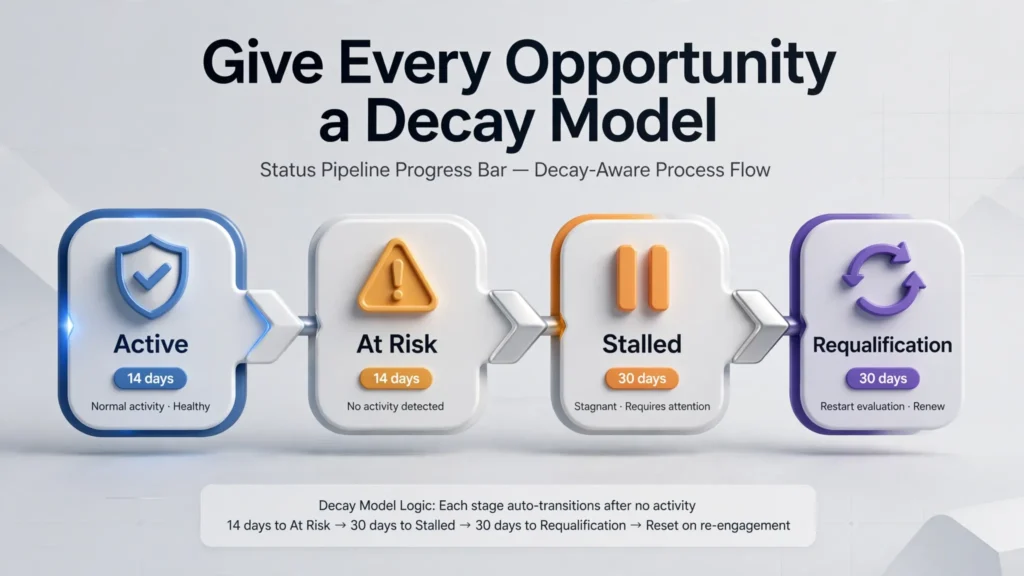
A useful rule might flag a discovery opportunity after 14 days without meaningful buyer activity, require requalification after 30 days, and remove it from active forecast after 45 days. Those values are examples, not universal benchmarks. Historical stage-duration data should determine the actual thresholds.
Prevent Duplicate Opportunities From Corrupting the Forecast
Duplicate records are particularly damaging in B2B because the same account can legitimately produce several contacts and several buying motions.
A simple deduplication strategy can start with normalized work email and company domain, then use additional matching signals where necessary.
normalize(email)
normalize(company_domain)
normalize(company_name)

if exact_email_exists:
    merge_or_attach_contact()
elif domain + account_name_match:
    attach_to_existing_account()
else:
    create_new_contact_or_account()
Opportunity deduplication requires more context. Two opportunities at the same company may be legitimate if they represent different products, business units, contracts, or buying projects.
Therefore, do not use “same account = duplicate opportunity” as a blanket rule. Compare the commercial motion, product, business unit, owner, contract period, and expected close date.
Build Forecasting From Historical Behavior
A pipeline report tells you what exists. A forecast estimates what is likely to become revenue.
The basic weighted-pipeline calculation is:
Weighted Pipeline =
    Σ(opportunity_value × historical_stage_probability)
But stage probability alone can be misleading.
Imagine two $100,000 opportunities in Proposal:
- Opportunity A entered Proposal three days ago, has an economic buyer engaged, and has a signed mutual action plan.
- Opportunity B has been in Proposal for 52 days, has changed its close date twice, and has no confirmed decision meeting.
Both may receive the same historical stage probability. They should not necessarily receive the same forecast treatment.
Useful forecast signals
- Historical stage conversion rate
- Time in current stage versus historical median
- Number of active stakeholders
- Economic buyer engagement
- Next-step existence
- Close-date changes
- Buyer response recency
- Deal size relative to historical segment performance
- Product or sales-motion win rate
- Closed-lost patterns for comparable opportunities
The objective is not to create an unnecessarily complicated predictive model. It is to stop treating every opportunity in the same stage as equally healthy.
Measure the Pipeline as a System
A useful dashboard should distinguish volume, movement, quality, and risk.
| Metric | Calculation | What it reveals |
|---|---|---|
| Stage conversion | Next-stage opportunities / entering opportunities | Where opportunities are being lost |
| Time in stage | Stage exit timestamp − stage entry timestamp | Where deals slow down |
| Win rate | Closed-won / eligible closed opportunities | Commercial effectiveness |
| Pipeline coverage | Qualified pipeline / quota | Potential revenue relative to target |
| Sales velocity | (Opportunities × average deal value × win rate) / sales-cycle length | Revenue movement efficiency |
| Stale opportunity rate | Stale open opportunities / open opportunities | Forecast contamination |
| Close-date slippage | Opportunities with moved close dates / opportunities | Forecast reliability |
Do not optimize these metrics independently. A team can improve stage conversion by disqualifying aggressively, reduce sales-cycle length by abandoning difficult deals, or increase coverage by creating low-quality opportunities. Metrics need to be interpreted as a connected system.
Handle Automation Failures Like Software Failures
Once CRM automation controls routing, enrichment, notifications, scheduling, and stage transitions, workflow failure becomes a business risk.
Common failures include:
- An enrichment provider times out.
- A webhook is delivered twice.
- A CRM update succeeds but the downstream notification fails.
- A rep is deactivated while holding open opportunities.
- A territory rule changes after opportunities already exist.
- A buyer submits two forms within several minutes.
- A workflow receives an event out of order.
Use idempotent automation
If the same event arrives twice, the second event should not create a second opportunity or duplicate an action.
event_id = incoming_event.id

if event_already_processed(event_id):
    return "already_processed"

process_event(incoming_event)

record_processed_event(event_id)
For workflows that update revenue records, retain an audit trail containing the event identifier, timestamp, source system, previous state, new state, and actor.
Do not hide failed automation
A failed workflow should produce an observable failure state. Silent failure is worse than manual work because the organization believes the process is operating when it is not.
At minimum, operational monitoring should identify:
- Unassigned qualified leads
- Expired SLAs
- Failed enrichment jobs
- Duplicate creation attempts
- Stage-transition validation failures
- Opportunities without next steps
- Opportunities with invalid close dates
- Stale opportunities exceeding their threshold
Validate the Pipeline Before Calling It Predictable
Pipeline validation should happen at three levels: record, workflow, and aggregate.
Record-level validation
- Does every active opportunity have an owner?
- Does every opportunity have an account?
- Is the expected value greater than zero?
- Is there a next action?
- Is the close date plausible?
- Are required stakeholder roles represented?
Workflow-level validation
- Can an opportunity bypass required stages?
- Can an unqualified lead become forecastable?
- Does routing produce an owner within the SLA?
- Are duplicate events safe to replay?
- Do failed integrations create observable errors?
Aggregate validation
- Are stage conversion rates changing materially?
- Is time-in-stage increasing?
- Is stale-pipeline percentage increasing?
- Are close dates repeatedly slipping?
- Is forecast accuracy deteriorating by segment or rep?
- Are certain lead sources producing volume without qualified opportunities?
This gives leadership a better question than “How much pipeline do we have?”
How much of the pipeline satisfies the evidence, timing, ownership, and buyer-engagement conditions required for us to trust it?
A Practical Operating Cadence
Pipeline governance does not require constant meetings. It requires the right checks at the right frequency.
| Frequency | Primary check |
|---|---|
| Daily | SLA breaches, unassigned leads, critical workflow failures |
| Weekly | Stalled opportunities, next steps, close-date changes, stage progression |
| Monthly | Conversion rates, stage duration, source quality, win/loss patterns |
| Quarterly | Stage definitions, qualification thresholds, routing rules, forecast model |
The quarterly review is particularly important. A pipeline model that was accurate when the company sold $20,000 contracts may be inappropriate after the average deal reaches $150,000 and procurement becomes part of the buying process.
What the Finished Pipeline Architecture Looks Like
Demand Sources
    │
    ├── Organic / SEO
    ├── Paid
    ├── Outbound
    ├── Partner
    └── Referral
          │
          ▼
Lead / Prospect Intake
          │
          ├── Deduplication
          ├── Enrichment
          ├── ICP validation
          └── Attribution
          │
          ▼
Routing
          │
          ├── Account ownership
          ├── Territory
          ├── Segment
          ├── Specialist requirements
          └── Rep capacity
          │
          ▼
Qualification
          │
          ├── Fit
          ├── Intent
          ├── Business problem
          ├── Authority
          └── Timing
          │
          ▼
Opportunity
          │
          ├── Discovery
          ├── Solution evaluation
          ├── Proposal
          ├── Negotiation
          └── Closed Won / Closed Lost
          │
          ▼
Pipeline Intelligence
          │
          ├── Conversion
          ├── Velocity
          ├── Coverage
          ├── Aging
          ├── Slippage
          └── Forecast
          │
          ▼
Governance
          │
          ├── Weekly inspection
          ├── Monthly analysis
          └── Quarterly model changes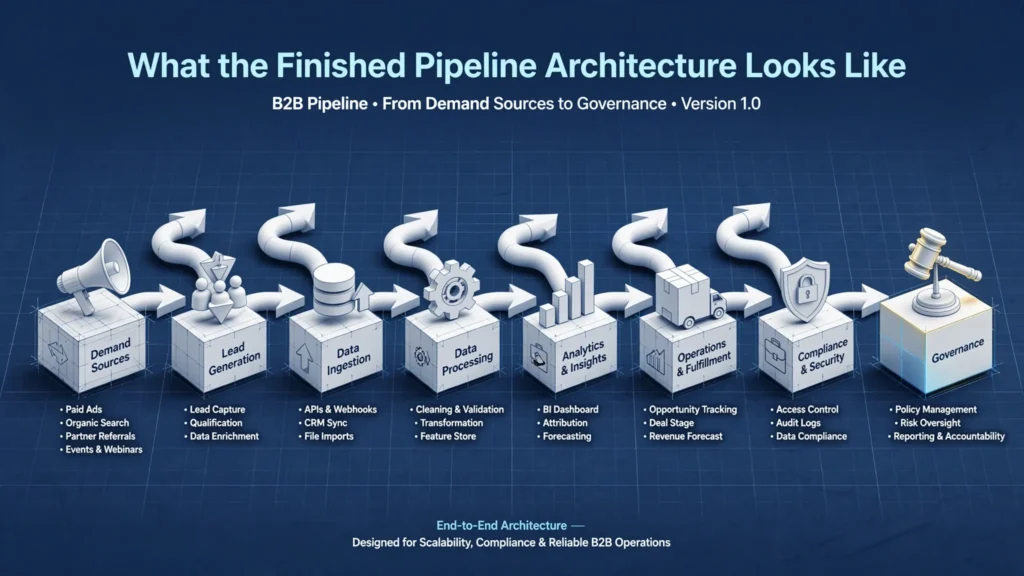
This architecture separates acquisition from qualification, qualification from opportunity management, and opportunity state from forecasting. That separation makes the system easier to audit and prevents one bad record from silently contaminating every downstream report.
Implementation Checklist
- 1Document the ICP and explicit disqualifiers.
- 2Define account, contact, lead, and opportunity ownership.
- 3Document stage entry and exit criteria.
- 4Identify mandatory fields for each stage.
- 5Define routing precedence and fallback ownership.
- 6Set response-time SLAs and escalation rules.
- 7Implement deterministic deduplication.
- 8Define stale, at-risk, and requalification states.
- 9Capture standardized closed-lost reasons.
- 10Calculate stage conversion and time-in-stage from historical data.
- 11Track close-date slippage separately from ordinary pipeline movement.
- 12Make workflow actions idempotent where duplicate events are possible.
- 13Maintain an audit log for automated state changes.
- 14Build dashboards around movement and risk rather than only pipeline volume.
- 15Review qualification, routing, and forecast rules on a defined governance cadence.
Key Tips for Better Pipeline Management
- Require evidence before allowing opportunities to advance.
- Separate account, contact, lead, and opportunity lifecycles.
- Use deterministic routing rules and explicit ownership fallbacks.
- Track buyer activity separately from seller activity.
- Give inactive opportunities clear health and decay states.
- Use historical stage behavior rather than stage labels alone for forecasting.
- Make automated workflows observable and safe to replay.
- Review pipeline quality as a system instead of optimizing individual metrics in isolation.
When to Review or Redesign Your Pipeline
Review the pipeline model when sales cycles, deal sizes, buying processes, or organizational structures change. A pipeline that worked when the company sold $20,000 contracts may no longer fit once the average deal reaches $150,000 and procurement becomes part of the buying process.
A redesign is also worth considering when close dates repeatedly slip, stale opportunities increase, routing breaks down, or forecast accuracy deteriorates by segment or representative.
Pipeline Data and Governance
Once CRM automation controls routing, enrichment, notifications, scheduling, and stage transitions, data quality and governance become operational concerns.
Maintain an audit trail for automated revenue-record changes that includes the event identifier, timestamp, source system, previous state, new state, and actor. Operational monitoring should also expose unassigned leads, expired SLAs, failed enrichment jobs, duplicate creation attempts, validation failures, and stale opportunities.
Frequently Asked Questions
What makes a B2B sales pipeline scalable?
A scalable pipeline has explicit stage definitions, evidence-based transitions, clear ownership, routing rules, qualification criteria, aging controls, automation monitoring, and forecasting based on historical behavior.
Why are CRM stages not enough?
Stage labels only describe where an opportunity appears to be. A reliable pipeline also defines the evidence required to enter and leave each stage, along with ownership, timing, and failure conditions.
How should inactive opportunities be handled?
Use operational health states such as Active, At Risk, Stalled, Requalification, and Closed Lost. The exact time thresholds should be based on historical stage-duration data rather than treated as universal benchmarks.
How can duplicate opportunities affect forecasting?
Duplicate opportunities can inflate pipeline coverage and make revenue forecasts less reliable. However, the same account can legitimately have multiple opportunities, so deduplication should consider the commercial motion, product, business unit, owner, contract period, and expected close date.
What should a pipeline dashboard measure?
A useful dashboard should cover stage conversion, time in stage, win rate, pipeline coverage, sales velocity, stale opportunity rate, and close-date slippage. These metrics should be interpreted together rather than optimized independently.
How should CRM automation handle duplicate events?
Automation should be idempotent when duplicate events are possible. The system should recognize an event it has already processed and avoid repeating the action.
Final Takeaway
A scalable B2B sales pipeline is not created by adding more CRM stages or increasing the number of opportunities in the database. It is created by making commercial state explicit and enforceable.
Every meaningful opportunity should have a known owner, a verified buying motion, evidence for its current stage, a defined next action, and a predictable response when momentum disappears.
Once those rules exist, automation becomes useful. Routing can enforce ownership. CRM validation can protect stage integrity. Workflow events can manage SLAs. Forecasting can use historical behavior instead of optimistic stage labels. And pipeline reviews can focus on exceptions rather than manually reconstructing what happened.
The goal is not a larger pipeline. The goal is a pipeline whose numbers survive contact with reality.
If your team is preparing for a CRM redesign, RevOps automation project, or forecasting overhaul, start by documenting the pipeline as a state machine: define every state, transition, owner, required signal, timeout, and failure condition before changing the tooling.